
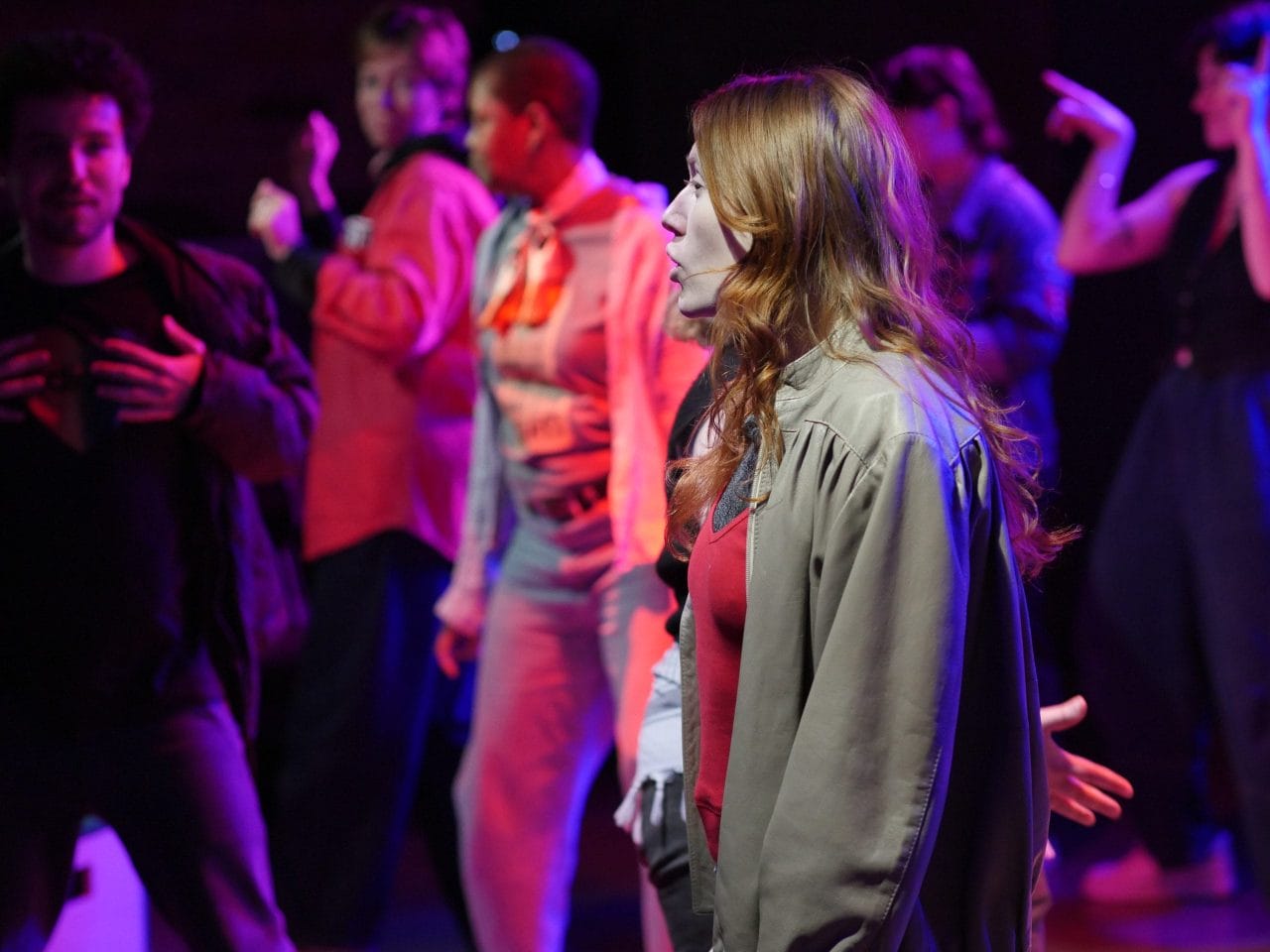
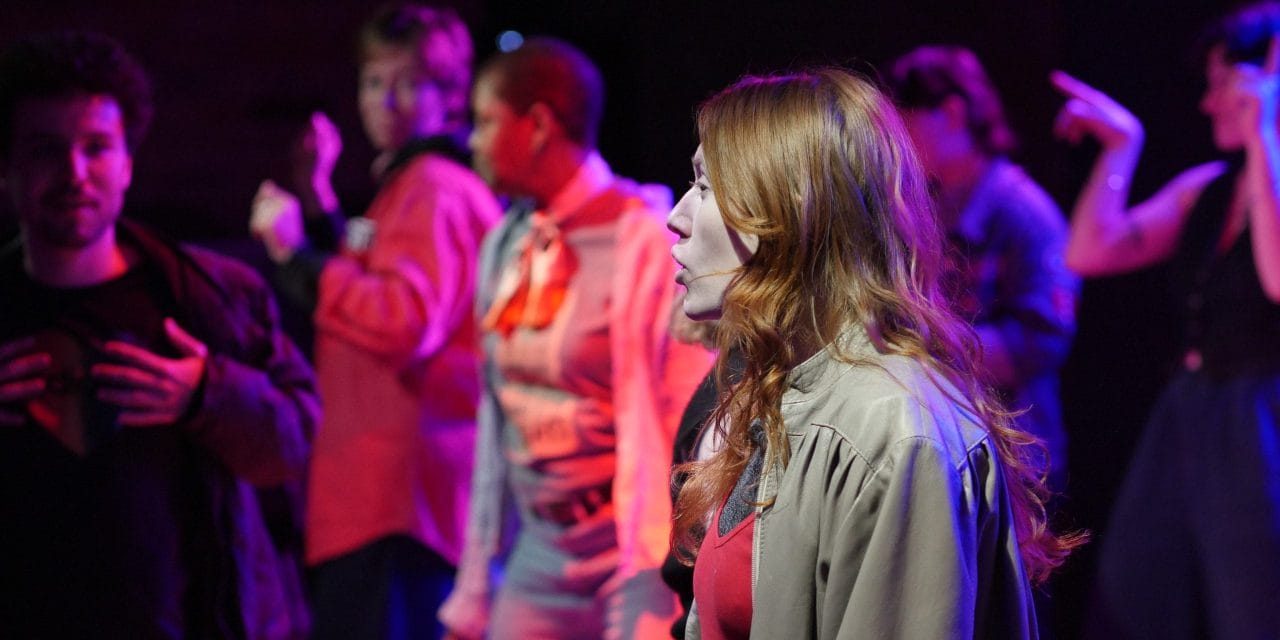
Arcola Theatre have been pioneers in targeted community theatre since their inception in 2000, placing participation and inclusion at the heart of their work for more than 25 years.
Throughout this time, Arcola has shown up for it’s community in delivering participation-based drama projects in close partnership with local charities, including Hackney Migrant Centre, Islington Migrant and Refugee Centre, CoreArts and many more, supporting them to engage with a wide and diverse range of participants from across Hackney, East London and beyond.
Shortlisted for The Stage Community Arts Award, Arcola welcomed 780 participants through its doors in 2025, each becoming part of the wider Arcola community. The theatre delivered 1,180 hours of activities last year, including workshops, rehearsals and other creative sessions. Artistic Director Mehmet Ergen reflects on the area’s diversity in The Stage Interview by saying – “This area has 70 or 80 languages in our schools, and bus [route] 73 has the most languages spoken in London. The work the Arcola puts on reflects this.” (The Stage, October 2025).
Arcola has witnessed many socio-political changes over the last 2 and a half decades, feeding directly into the truth-speaking and civic engaged nature of the work, one which provides a platform and a voice for democratic dialogue within the communities that need it most. The participation sessions were born out of a pure and authentic interest from the local community, emerging initially with a 50+ and a Youth Theatre group and then expanding throughout the years to two more groups such as Queer Collective and Mental Health Community. Those with experience of migration and displacement are welcomed by the Sawa Community Theatre Company, providing an inclusive space for refugees. The Arcola Youth Theatre introduces young people aged nine to sixteen to every aspect of theatre-making, from performance to the creative processes behind the scenes. Those who wish to continue their journey can progress to the Arcola Academy, where they begin their professional development and, in some cases, make their stage debuts in productions from which some members have progressed to professional acting roles.
What began as a participation programme has grown into one of Arcola’s staple contributions, celebrated by General Manager Charlotte Croft and Participation Manager Aoife Beaumont in a recent interview with The Stage, Croft says – “Staying in tune with our communities has always been at the heart of our participation work, That’s why we open our doors to so many different groups – giving like-minded people the space to meet, make, and express themselves.”
Beaumont echoes – “There are quieter victories, too, which, for us, are just as, if not far more, meaningful… We’ve had participants who have re-established hope and meaning in the world and participants who have felt empowered to make changes in their personal lives, returned to work or re-enter society. That’s the real power of accessible, inclusive theatre – it can change things for people.”
In a recent interview with the founder Ergen with The Stage Magazine, he stated – ‘We’re very bold. And we’re doing this with less funding [than comparable London theatres].”
Arcola has been an NPO, National Portfolio Organisation, since 2011, but with recent funding caps, against a backdrop of austerity, the cultural landscape continues to feel precarious, making external funding partners and ticket sales even more crucial to obtain. Arcola are always weighing up how to make their work financially viable while maintaining a commitment to humanity, socially engaged topics and devising plays that are accessible.
Participation
Arcola Theatre works in close partnership with a wide network of local organisations to reach participants who may benefit most from its programmes. Through these relationships, the theatre ensures that its participation work remains accessible, relevant and rooted in the needs of the surrounding community.
In this context, “specialist theatre” differs from mainstream theatre-making. It refers to work developed with groups who bring lived experience of mental health challenges, addiction recovery, or other complex life circumstances into the creative process. While participants and artists often describe the sessions as therapeutic, they are not presented as therapy. Instead, they are carefully facilitated creative spaces, environments where individuals are supported, heard and empowered to share their voices safely, collaboratively and without judgement.
During my placement with Arcola Theatre, I stepped into rehearsal rooms where theatre is not simply performed, but lived. Over the past months, I have observed and taken part in participation sessions that will culminate in a week-long Community Festival at the end of March, a celebration of work built entirely from the voices, experiences and imaginations of its participants.
The Mental Health Community Company are currently devising an original production shaped around food, memory and the powerful associations that connect the two. The rehearsal room is collaborative and participant-led; stories are shared, improvised, reshaped and intertwined. A memory of a kitchen table can open into something much larger; about comfort, survival, belonging.
Maria, a long standing member, speaks about discovering chips as a young person and the unexpected solace this simple meal offered her during a difficult period in her life. Her story sits alongside others that are equally personal. In a previous interview, she shared:
“In order to stay alive as a kidney patient I have to do dialysis with needles in my arm every two days. The only things that keeps me alive, apart from my garden, are my drama and theatre. The Arcola MH group is the best thing in my life. I have made friends and been able to act on stage and do something that I love. And it is the only thing that gives me the mental health capability to cope.”
For facilitator Josh, the impact of the work extends far beyond performance.
“Our past projects have been the catalyst for people to rejoin society, encouraging them to apply for jobs or training and make positive changes in their personal lives,” he explains.
The group’s ethos is echoed by Michelle in a recent interview, who describes the company as more than a creative outlet:
“We create theatre based on lived experiences of our mental health. It’s a wonderful community to be a part of, and it really makes you feel alive.”
What emerges in the rehearsal room isn’t just a play, but a testament to shared experience, a reminder that theatre, at its most powerful, is a space where personal stories become collective strength.
The 50+ Group takes to the stage with a bold, forum-theatre–inspired political debate, centring on the threatened closure of a fictional community hall Ashwin Hall. This is more than a story about bricks and mortar. It is a journey through time and heritage.
Across the performance, the audience is transported through decades of the hall’s life-line, glimpsing the moments that have defined it. A wedding reception filled with music and laughter. A fitness class and sexual health clinic offering quiet reassurance. A book club in animated discussion. A soup kitchen serving warmth alongside sustenance at Christmas. Each scene builds a portrait of a space that has quietly held the stories of everyday life and real people.
As the debate unfolds, the production becomes both playful and pointed, inviting reflection on who gets to decide the fate of shared spaces and what is lost when they disappear. In revisiting the hall’s many incarnations, the group crafts a moving tribute to local history and a passionate defence of community itself, championing the vital role these spaces play in holding neighbourhoods together.
“This group has helped me rediscover creativity and also, being part of an inclusive group, strengthened my links to various local communities.” said Charlie, a member of the 50+ group.
Another member of the group, Mary, brings her own history of protest into the rehearsal room, a legacy that has shaped elements of the play itself. Reflecting on her activism campaigning for abortion rights, she describes how political engagement transformed her sense of the world.
“Politics was how I got out of my narrow social groove. We would go up to the picket lines and there was this importance of ideas. If we want to have rights, we need to protect them.”
For Mary, those experiences were not only about policy, but about connection, standing shoulder to shoulder with others in pursuit of something larger than oneself. Yet she also reflects on what feels diminished today:
“There’s not enough connective tissue between people these days, and real community is hard to find. We don’t know who our neighbours are.”
Her words resonate powerfully within a play concerned with the fate of a community hall, a space designed, at its core, to bring people together.
The final group I have had the pleasure of supporting during my placement is the Queer Collective at Arcola Theatre, a fiercely self-directed ensemble whose rehearsal room feels as much like a research space as it does a studio.
Together, they are interrogating the history of protest, exploring how queer activism has not only fought for its own liberation but has stood in solidarity with other movements across decades. Their conversations stretch from the women-led peace camp at Greenham Common Women’s Peace Camp to the global momentum of Black Lives Matter and the ongoing calls for justice within the Free Palestine movement. What emerges is a tapestry of interconnected struggle, a reminder that queer resistance has long energised and emboldened wider campaigns for change.
Music and movement pulse at the centre of the work. Protest songs thread through the performance, not simply as historical reference points but as living, breathing acts of solidarity. Collective choreography and shared rhythm transform the stage into a site of unity, underscoring the idea that gathering together, in voice, in body, in joy, can itself be radical. In this rehearsal room, joy is not escapism; it is defiance.
Jess, who facilitates the Queer Collective, recently shared insights into the group’s new production for the Community Festival:
“Our show is an exploration of what protest means today, linking queer activism with movements like Greenham Common. We look at how queer people use their platform to support other causes and marginalised groups, creating allyship and a call to action. The group examines the broad meaning of protest and ways to inspire people to engage more. What makes this group so unique is that we flatten the usual hierarchical lines often found in theatre organisations. While the facilitators guide the process, the ideas and the energy come entirely from the participants themselves.”
Duncan, a performer in the Collective, explains his role in the production to his friend Nik:
“I play your opposition, the newsreader ‘Sue Law and Order’ who tells the world what’s right or what’s wrong. This play is about a group of people unbridled in their fight. It’s about protest, resistance, and joy. We’re in the middle of rehearsals, and there’s still so much to uncover.”
For the participants, the rehearsal room offers a rare space of freedom and authenticity. Christina reflects:
“This is a place where I can go and feel and be myself without explanation. I can be unapologetically creative in a space without a mask. It’s really nice to navigate through life authentically.”
Nik echoes this sentiment:
“For me, these sessions are a protected time where I can play and be creative with other queer people.”
Duncan adds:
“I’ve gained a greater sense of self-confidence. I live louder and prouder, and I celebrate my existence as a form of resistance, for myself and other queer people in the world.”
Together, these voices capture the essence of the Queer Collective: a space where creativity, activism, and joy collide, reminding everyone that protest is as much about self-expression and community as it is about politics.
What becomes unmistakable across all three groups is that these participation sessions are not an adjunct to the work of Arcola Theatre, they are central to it. In rehearsal rooms above and beyond the main stage, theatre is functioning as something vital: a meeting point, a support network, a platform, a catalyst.
For participants, the impact is personal and immediate. These sessions offer structure, creative release and, perhaps most importantly, belonging. They create spaces where lived experience is not only welcomed but valued; where stories that might otherwise remain private are shaped into collective expression. But the effect does not stop at the rehearsal-room door. When these works are staged at the Community Festival, the ripple widens. Audiences encounter narratives rooted in their own borough, stories of protest, of survival, of memory, of joy. The performances invite conversation about mental health, ageing, queerness, community spaces and civic responsibility. They remind us that culture is not something imported into a neighbourhood, but something generated from within it.
In a time when genuine connection can feel increasingly fragile, these participation groups model a different way of being together. They demonstrate that creativity can be a form of care and a living testament to what can happen when people are given space, voice and the courage to stand side by side.